Renting and climate change in Tāmaki Makaurau/Auckland
Author:
GravitasOPG, Sue Allison, Terry JonesSource:
Auckland Council | GravitasOPGPublication date:
2026Topics:
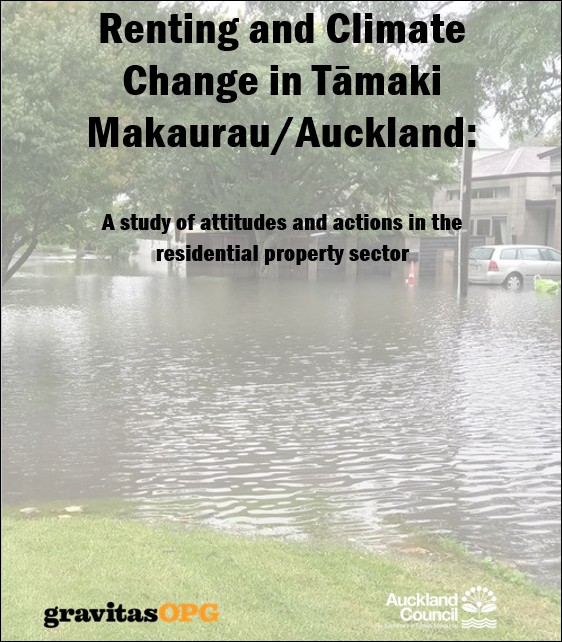
Environment ,PeopleRenting and climate change in Tāmaki Makaurau/Auckland: A study of attitudes and actions in the residential property sector
From the Executive summary
Introduction
Te Tāruke-Ā-Tāwhiri: Auckland’s Climate Plan, adopted in 2020, sets out eight priority areas to reduce emissions and help communities adapt to climate disruption. Since adoption of the plan Tāmaki Makaurau has experienced severe climate-related events, including flooding due to storms over Auckland Anniversary weekend in January 2023, followed by Cyclone Gabrielle two weeks later. These events caused loss of life, widespread damage and displacement, and highlighted the need to strengthen action and future-proof Auckland against future events.
As part of its broad response to the devastation wrought by the floods, Auckland Council established Resilient Tāmaki Makaurau, a comprehensive and long-term programme to build a more resilient Auckland through changes to land-use planning provisions, infrastructure investment and working with Aucklanders to speed up community adaptation. The development of the Flood Viewer, a free online map which provides clear and accessible information about potential flood risks to Auckland properties and how to prepare, was accelerated.
The 2023 floods highlighted that some groups face additional challenges to climate adaptation. One such group is residential property tenants. Landlords in New Zealand are not legally obligated to disclose climate-related hazards, or to take steps to reduce property-based carbon emissions. There is a knowledge gap regarding residential property managers and landlords voluntary disclosure of flood hazard risks to prospective tenants. Similarly, it is unclear whether renters actively seek information about flood risks as part of their decision-making process including their engagement with Flood Viewer.
This research was commissioned by Auckland Council’s Healthy Waters and Flood Resilience and Policy departments with the purpose of exploring climate-related attitudes and actions among residential tenants, property managers and landlords in Auckland. This included responses to flood hazard risks and broader efforts to improve property resilience and personal preparedness, as well as efforts to reduce climate-related hazard risks and carbon emissions.
Method
In-depth one-on-one interviews were conducted with 50 stakeholders from the private residential rental sector, including 25 tenants, 15 landlords and 10 property managers. A range of participants were recruited to ensure diversity across key variables.
Interviews were carried out online and in person, recorded and transcribed, and thematically analysed. Interviews were conducted between August and October 2025.
This research project went through an Auckland Council-led ethical review process, following best practice guidelines (review number 2025-05).
Findings
Tenants generally did not seek out information on climate-related hazards when choosing rental properties, often assuming risks will be disclosed by landlords or property managers. Tenants with reduced choice had limited options to avoid high-risk homes. Prior flood experience increased the flood risk awareness for some tenants.
Disclosure to tenants of climate-related hazard risks was low. While landlords and property managers expressed a theoretical willingness to share risk information, disclosure was inconsistent and often limited to historical impacts rather than potential future risks. This intention-action gap was driven by low awareness of property-specific hazards, lack of regulatory requirements, and concerns about property value and tenant demand. Reliance on past flooding as a proxy for potential future potential risk reinforced a false sense of security, leaving significant knowledge gaps across the sector.
The study found a gap in proactive climate adaptation by landlords and property managers. Provision of educational resources was largely reactive, with guidance provided by some during extreme weather warnings and a general lack of focus on long-term property adaptations. Advice, guidance, or support were rarely provided, despite a stated willingness among landlords and property managers. Where information was provided, it was narrowly focused on immediate, event-specific actions rather than broader resilience measures.
Short-term readiness measures for extreme weather events were more common than long-term property adaptations. Adaptation activity remained low due to limited awareness, perceptions that adaptation was unnecessary, financial barriers, and lack of regulatory requirements. Property managers highlighted how they could not authorise or fund upgrades, and concerns about tenancy termination deter some tenants from requesting changes.
Awareness and use of Auckland Council’s Flood Viewer was low across residential rental sector stakeholder groups, with the primary barrier being lack of awareness. Property managers and landlords often relied on past experience and local knowledge rather than digital tools. However, when introduced to the Flood Viewer during interviews, both landlords and tenants showed an interest in using it for future decisions, highlighting an opportunity to increase adoption through targeted promotion.
Property-focused emission reduction activity in Auckland’s rental sector was minimal, despite strong support among those we spoke to for environmental sustainability. A persistent intention-action gap was driven by limited awareness of feasible measures, financial barriers, and absence of regulatory requirements. Renovation cycles offered the best opportunity for landlords to invest in emission-reducing upgrades, supported by financial incentives and subsidies.
Climate-related hazard awareness and disclosure in the private rental sector are marked by significant gaps across all stakeholder groups - tenants, landlords, and property managers. Reliance on informal knowledge rather than formal risk-assessment tools such as the Flood Viewer results in limited awareness and transparency around exposure to climate-related hazards.
A central finding is the power imbalance that shapes how information flows within the sector. Property managers depend on landlords for climate-related hazard risk information. Tenants, especially those with fewer housing choices, were often left unaware of climate-related vulnerabilities until after adverse events and may feel unable to request property adaptations due to fear of repercussions.
Non-disclosure is not always intentional; many landlords are simply unaware of risks until they experience impacts firsthand. As a result, disclosure tends to focus on past events, with little attention given to future climate risk. Although landlords express a sense of responsibility for resilience, action remains largely reactive rather than proactive, constrained by cost concerns, limited awareness, and competing priorities. This reflects a broader intention–action gap, also evident in emissions reduction behaviours across the sector.
Overall, the system’s effectiveness is hindered by knowledge deficits, risk tolerance, and low willingness to invest ahead of time. Strengthening stakeholder understanding, increasing use of the Flood Viewer, and introducing regulatory requirements for hazard disclosure would improve transparency and support better climate resilience for tenants. Empowering renters with accessible risk information would also enhance their ability to make informed housing decisions. ...
Auckland Council, GravitasOPG, March 2026