Green skills Māngere: BikeFIT community mechanic training pilot. Evaluation report, February 2026
Author:
Auckland Council Economic Development Office, The Southern InitiativeSource:
Auckland Council Economic Development Office, The Southern InitiativePublication date:
2026Topics:
People ,EconomyExtract from the Executive Summary
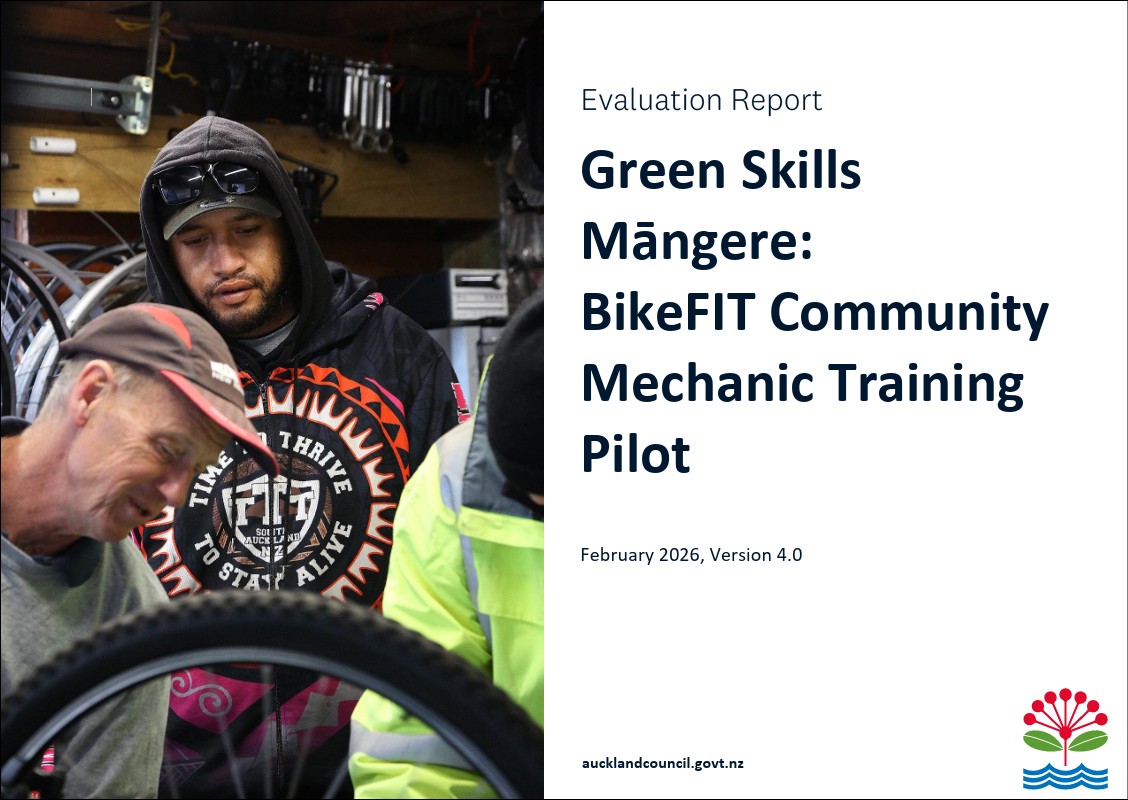
This report outlines the outcomes and lessons from a 12-week community bike mechanic training pilot delivered between June 2025 to November 2025. The pilot was funded by Auckland Council and Auckland Transport, and delivered by Time to Thrive (Triple Teez), in partnership with the New Zealand Bicycle Training Academy.
While framed as a community bike mechanic training programme, the pilot functioned as a broader community capability and workforce readiness initiative. The success of the pilot is due to it being co-designed and delivered by trusted community organisations, showing that learners are more likely to participate, stay engaged, and believe in their own ability to succeed.
No formal advertising or recruitment campaign was held, instead participants joined through their existing relationship with the community bike group, Triple Teez. The programme’s strong cultural grounding, wrap-around pastoral support, and relational teaching created a safe, whānau-like environment where learners could build skills and grow their confidence, while staying actively engaged. Technical aspects were delivered by Rene van Rijn from the New Zealand Bicycle Training Academy, a respected industry trainer, which helped build wider industry credibility and confidence in the training programme.
Key outcomes included improved technical skills, increased confidence, work-readiness, stronger peer support, and meaningful contribution back to whānau and community. While long-term employment outcomes are not yet measurable, learners experienced immediate gains in confidence, purpose, and practical capability.
This pilot also highlighted important system lessons. Community organisations like Triple Teez often work across transport, climate, youth development, and skills development, yet council systems are often siloed and administratively complex. Where council teams worked together around shared objectives, delivery was smoother, more flexible, and less burdensome for community partners, resulting in greater collective impact.
Overall, this pilot offers a strong, place-based example of how community-led training can build local capability and social value over time as part of a wider infrastructure delivery programme. The findings highlight that community hubs can act as vital workforce infrastructure, providing culturally grounded, supported learning while creating clear pathways into further training, employment, and leadership. ...
Auckland Council Economic Development Office, The Southern Initiative, February 2026