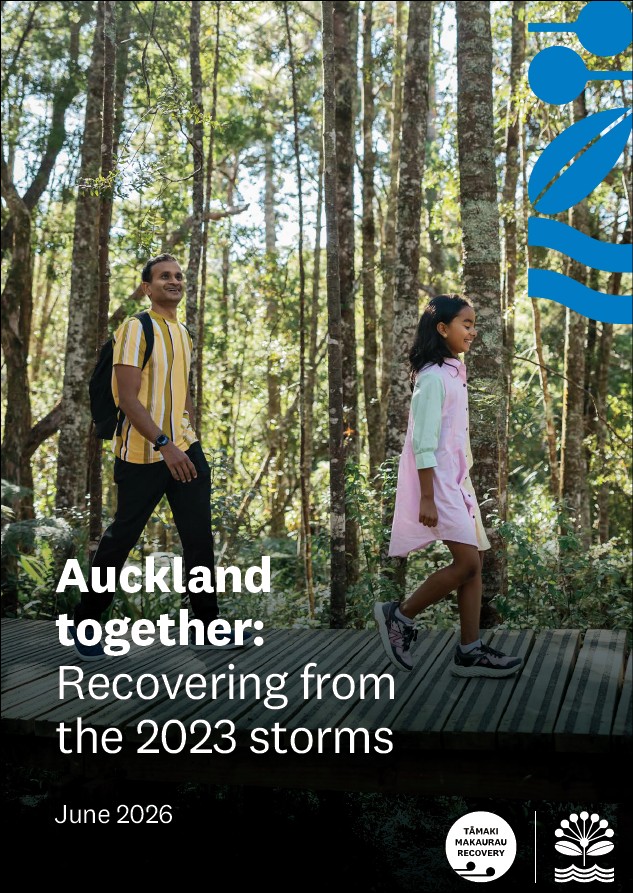
Auckland together: recovering from the 2023 storms
Author:
Tāmaki Makaurau Recovery OfficeSource:
Tāmaki Makaurau Recovery Office, Auckland CouncilPublication date:
2026Topics:
Environment ,PeopleMayoral foreword
In 2023 Auckland endured five extreme weather events, two of those required a state of emergency. These events reshaped our city and have drastically changed the way we now build it.
It highlighted our weak points physically, financially and logistically. But what happened next was also of magnitude. The way people pulled together was astonishing and I believe lives were saved because ofit. I still hear stories about what people did during the floods and the cyclone. These stories are humbling,some of them are included in this report. Our Auckland Emergency Management team worked around the clock to address urgent needs, restore services, and support communities at Civil Defence Centres while working with the National Coordination Centre following the declaration of a national state of emergency. Once it got going, the plan worked.
Moving from response to recovery, building and land assessments begun, a Solid Waste Action Plan was put together for all the rubbish that littered our streets and Healthy Waters and Watercare crews went about the huge task of clearing out water blockages throughout the city.
Auckland Council stood up a whole new office in the Tāmaki Makaurau Recovery Office to address the damage and guide Auckland through its recovery. This in itself was a mammoth task. We worked with government to change laws and to fund strengthening the resilience of Auckland through its infrastructure and built and natural environments. We consulted with Aucklanders on what they thought recovery should look like to give the office direction from communities.
The Recovery Office offered buyouts to 1200 Category 3 property owners and expects to purchase around 1150 of these. The office has made the most of these homes, relocating a third of them and diverting 80 per cent of material away from landfill.
Separate to the Office, our Long-term Plan 2024/2034 invested significantly in critical infrastructure to strengthen the physical resilience of Auckland and we stood up the Auckland Future Fund to build financial resilience into council’s books.
2024-2025 saw record investment in Auckland: $3.9 billion, the highest capital programme in our history. It focussed on where investment is needed the most – on managing Auckland’s growth and building resilience to the impacts of climate change. This included major progress on the City Rail Link and Central Interceptor, the backbones to our transport and water infrastructure. We invested $1.2 billion in water infrastructure to ensure safe, reliable services, reduce wastewater overflows, and protect the environment and $1.5 billion in transport upgrades to improve access to public transport, reduce congestion and upgrade key travel routes.
While these projects are securing Auckland’s future, the lessons we learned along the way belong to everyone. The strategies detailed in this report are born from hard-earned experience, and they offer a roadmap for any city looking to fortify itself against an unpredictable climate. It is my hope that cities the world over use this document to help prepare for these escalating events. It’s not if, it’s when.
Auckland Mayor
Wayne Brown
A message from the Group Recovery Manager
The severe weather events of early 2023 have left an indelible mark on Tāmaki Makaurau and on the people that call it home. Flooding and landslides caused widespread damage, took lives, and left thousands of people displaced and uncertain about whether their homes were safe to return to. Parts of our roading network, water supplies, community facilities, and stormwater infrastructure were overwhelmed or destroyed. In the aftermath, there were effectively two Aucklands: one where life returned to normal, and one where daily life remained disrupted and the future deeply uncertain.
In the three years that followed, people from Auckland Council, the government and its agencies, community partners, and volunteers from affected neighbourhoods worked tirelessly to support those that were most affected and to repair the damage those devastating events caused.
Throughout the recovery we relied on the knowledge, experience and generosity of others to help the programme move forward. We extend our sincere thanks to everyone that has contributed and continue to work on creating a more resilient Tāmaki Makaurau.
Central to our recovery efforts was support for Aucklanders as they worked through a complex and unfamiliar system. The Storm Recovery Navigation Service was established to work directly with individuals and whānau, helping them to understand what was happening, access support and stay connected to services. For many people, having a navigator alongside them was what made the process manageable, turning something overwhelming into something they could work through.
Recovery is something that must be done with communities. From the earliest days, Auckland communities showed extraordinary resolve, and some of the most effective work happened when we stepped back and trusted local knowledge and relationships to guide the way. Where decision-making was genuinely shared, the outcomes were more meaningful and will be enduring. The contribution of communities is woven throughout the recovery.
Recovery was an opportunity to support iwi to exercise kaitiakitanga within their rohe to address the impacts of the severe weather events and to respond to the changing climate. Iwi engaged in the recovery highlighted the fundamental importance of building enduring relationships, regular communication, and a structural commitment to partnership through recovery and future resilience.
More than 3,500 properties were assessed to understand the level of risk to people living in them. For many households, this led to difficult decisions about whether they could stay or needed to move on. Others were supported to make changes so they could remain safely in their homes. Communities across the region have also benefited from investment in local initiatives to reduce risk and support neighbourhoods to recover.
Alongside the homes programme, we undertook a large programme of infrastructure repair and improvement. Roads, parks, water and wastewater systems all required significant investment, with hundreds of repair projects completed. In many cases, those repairs became an opportunity to build in greater resilience rather than simply restore what had been there before. Four major stormwater projects were accelerated under the recovery programme, and two of those – in Māngere – will be complete in 2026.
This report provides a record of that work. It documents what was delivered through recovery, the decisions that were made, and the scale of the effort involved, while also capturing the observations and experience of those involved. It is intended as a resource for communities, decision makers, practitioners and others involved in future recovery efforts. By setting out both what was done and what was learned along the way, the report offers a clear reference point for understanding this recovery and for shaping how similar events are approached in the future.
While much of the physical damage has been repaired, the social impacts of the events will remain with many Aucklanders for years to come. I am acutely aware that for some, the recovery is still very much ongoing.
Auckland Council too has been on a journey. The experience of this recovery has made it clear that responding after the fact is the hardest and most expensive option. Significant work has been done to improve our emergency response capability and build permanent recovery skills within the council. We now have a far greater understanding of flood and landslide hazards because of the data collected through the recovery, and this knowledge is already shaping how we prioritise council funding and effort to reduce the toll that future weather events will have on people living in Auckland.
Reflecting on everything this recovery has asked of us, I want to share three observations that I hope will carry weight beyond this programme. They reflect our formal recommendations and are things I consider matter deeply for where we go from here.
How and where we build must change. The storms made plain what the data had long suggested; that we cannot keep building and living in places where the risks are growing. A clear adaptation pathway that sets minimum standards, accounts for future hazard and is honest about the areas from which we need to retreat, is overdue. Our planning framework needs to reflect that reality.
Risk information must be shared more openly. One of the frustrations through this recovery was that hazard and risk information existed but it wasn’t always accessible or understood by the people who needed it most. There needs to be a genuine commitment across all authorities to make this information available and usable so people can make good decisions.
New Zealand needs national leadership on risk reduction and adaptation. The 2023 recovery had practical limits, such as being focussed on areas where the storms had impact and where owners have voluntarily participated in the risk assessment programme. This means in Auckland, like many other regions around the country, people continue to live in hazard-prone locations. Without a nationally adopted framework, New Zealand’s effort and funding will continue to default to recovery rather than resilience and adaptation. This keeps costs high and exposes communities to repeated harm.
The Recovery Office is closing but the work does not stop. Delivering resilient infrastructure, supporting community resilience, completing changes to the Auckland Unitary Plan for natural hazards, and looking honestly at the future realities of climate adaptation all continue. This recovery has given us a new starting point and a clearer picture of what the work ahead requires. I hope this report serves as a useful record of what we achieved together, and as a resource for those who will carry this work forward.
Mace Ward, Group Recovery Manager
Auckland Council, June 2026
See also
Operational lessons and recommendations from the Tāmaki Makaurau Recovery Office.
June 2026
Strategic observations and recommendations from the Tāmaki Makaurau Recovery Office.
June 2026
Lessons from the 2023 recovery: summary
Auckland Council Governing Body report, 30 June 2026
Tāmaki Makaurau Recovery: observations, operational delivery and recommendations
Auckland Council website