Auckland economic update May 2026
Author:
Ross WilsonSource:
Auckland Council Social and Economic Research and Evaluation TeamPublication date:
2026Topics:
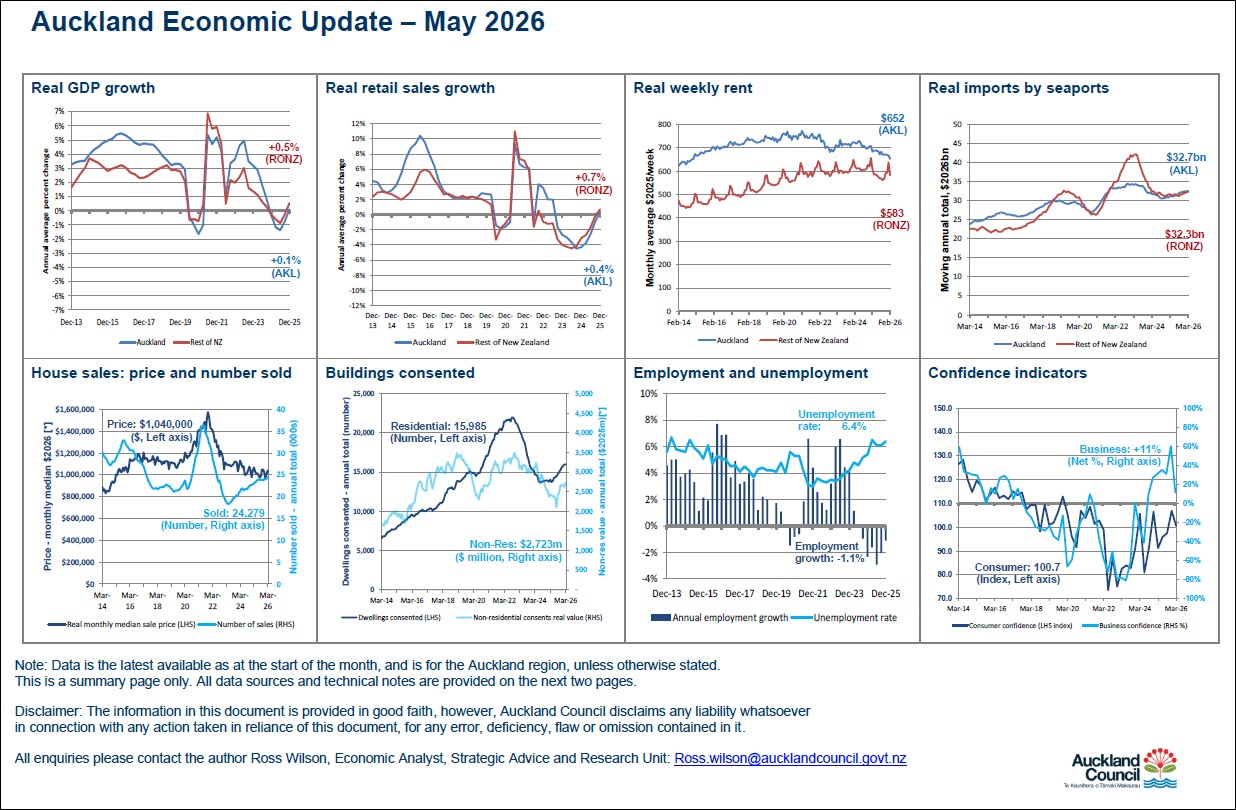
EconomyAn overview of the Auckland economy for May 2026, in charts and graphs and with some commentary.
Measures covered are: house prices and numbers sold, weekly rents, building consents, employment and unemployment, GDP, business and consumer confidence, retail sales, imports.
Highlights include:
- business confidence (NZIER QSBO) for the March quarter showed a net 11% of businesses expecting the general business situation to improve over the next three months: a sharp drop from December’s record high (60%), to the lowest level since 2024 - although still above most of 2017 to 2024;
- median house price for the month of March was $1,040,000, which in real* dollars was: similar to the last two years; 34% below the 2021 record peak; similar to what it was ten years ago);
- number of houses sold for the year ended March was 24,279: fairly flat since July 2025; 32% above the May 2023 trough; 33% below the 2021 peak; a little above the mid-2017 to mid-2020 trough
- average weekly rent for the month of February was $652 (in real* dollars: trending down since mid-2024; 16% below the February 2021 peak; same as it was eleven years ago). For the rest of New Zealand, the figure was $583 (8% lower than the month before (but highly seasonal); trending down for over a year; the lowest February figure since 2019);
- number of new dwellings consented in the year ended March was 15,985: similar to February, after rising steadily by 14% in a year; 27% below the September 2022 peak; 5% above the 2019 pre-Covid trough;
- real* value of new non-residential buildings consented in the year ended March was $2,723 million: 4% above the previous four months; 30% above the August 2025 trough, but below most of 2017 to 2024; 22% below the 2022 and 2019 peaks;
- real* value of imports by Auckland seaports for the year ended March was $32.7 billion: steadily rising by 7% since October 2024, still 5% below the April 2023 peak, but 22% higher than the 2020 Covid trough, and trending up since 2014. For the rest of New Zealand, the figure was $32.3 billion. Auckland has been around half the New Zealand total or less since 2018; before then it was mostly more than half.
*Note: real dollars/values are after adjusting for the effects of inflation each quarter, so a similar ‘real’ level means that a value rose at a similar rate to inflation.
May 2026
Previous updates.
2025